The musings of a previously unemployed Jewish Freemason. I write about the job search, about Judaism, and about Freemasonry.
Showing posts with label Numbers. Show all posts

Tuesday, July 17, 2012

Masei: Cities of Refuge

This Torah portion recaps the journey the Israelites took through the desert on their way to Canaan. Then God tells Moses the rules for the invasion of Canaan, ironic considering that God has ordered Moses' death on this side of the Jordan River without permitting him to set foot in Canaan.

God tells Moses that the Israelites are to drive out the current inhabitants of Canaan, who have committed offenses to God bad enough that the Israelites are the retribution God has planned for the Canaanites. The Israelites are to destroy all the idols and altars of the Canaanites. The Canaanites who remain, God predicts, will be "that those which ye let remain of them shall be pricks in your eyes, and thorns in your sides, and shall vex you in the land wherein ye dwell. Moreover it shall come to pass, that I shall do unto you, as I thought to do unto them." [Numbers 33: 55-56]. The Hebrew of "pricks in your eyes" is "bee stings in your eyeballs". Not a comforting image.

Then God defines the borders of the Promised Land. I'm not going to bother to quote this part (it's not like the Bible isn't readily available), since it has become the justification today for Religious Zionists to occupy the West Bank and Gaza, as well as some Transjordanian land as well, claiming that this ancient promise justifies their actions.

Because the Levites are not a tribe in the same sense that the other tribes are, they are given cities and their surrounding suburbs for their tribe. After describing these cities, God explains that a few of the cities will be designated Cities of Refuge. If a person commits manslaughter, they can escape to a city of refuge, and the city will protect them from the victim's family's vendetta until there can be a trial. The manslaughterer can find refuge in the city, and will be safe until there can be a fair trial. The passage defines the difference between murder and manslaughter. I'm not aware of a more ancient text to make the distinction.

But not only does the Bible make that distinction, but God will, later on in the Bible, designate six particular cities to be cities of refuge. To me, this seems particularly noteworthy. Who would want to live in a city of refuge, knowing that potential murderers, and people who want to kill them, will show up there? But there is also mercy in this, as these cities of refuge provide asylum for those who accidentally kill others.

The passage ends with resolution for the daughters of Zelophehad, who are told to marry within their tribe, so that their inheritance, while theirs, does not pass to another tribe when they marry.

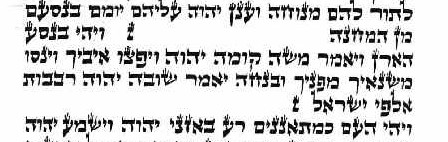
It is customary in Torah study, when a student or group of students finishes studying a book of Torah, to say: chazak chazak v'nitchazek. This could be translated as "Be strong! Be strong! And may we be strengthened."
חזק חזק ונתחזק

Monday, July 16, 2012

Matot: have ye saved all the women alive?

This is another week with a double Torah portion. This portion has three major themes. The first is the sanctity of vows. Men and divorced or widowed women are to keep their oaths and obligations. Wives and dependent daughters, if they make vows, can have those vows vetoed by the man responsible for them. This is problematic for a modern, egalitarian sensibility, but is pretty standard for a heavily patriarchal culture.

This veto is a double-edged sword, in a sense. God is merciless to the man who makes an oath he cannot honor, but shows some mercy to the woman who makes an oath she cannot fulfill. This mercy is entrusted to her patriarch, who can decide for her that she cannot be obligated to carry out her obligation, provided he objects within a day of her oath. In one sense, it is profoundly insulting to the woman's autonomy that a patriarchal figure in her life has veto power over her agreements. However, much of Jewish law is how to get rid of an obligation that one has made but cannot fulfill, and Jewish law is much kinder to women than to men who fail to meet their obligations.

The second theme is Moses' vengeance on Midian for the heresy of Baal-Peor. Recall that the Israelites have been journeying through the wilderness, and on the plains of Moab are nearly done with their journeys. They have been seeking passage to Canaan, and finding various nations have opposed them in their attempt to enter the land. First, the Israelites responded by avoiding their opponents, then when later opponents attacked them, they cursed their cities and avoided them, still later, when their opponents attacked them, they defended themselves and took the battle to their opponents, killing them. Finally, with Midian, the Israelites engage in a war of extermination.

God tells Moses that he is to organize a surprise attack on Midian, and that afterwards, Moses will die, and cede leadership to Joshua. Moses gathers a force of 1000 men from each tribe, and these shock troops, led by Pinchas ben Eleazar the priest, mount a surprise attack and slaughter every adult male in Midian, and take the women, children and livestock captive, along with all their valuables and possessions. They single out and execute by sword the five kings of Midian, along with Balaam the sorcerer (although presumably his donkey was spared). All of the buildings in Midian are set on fire.

Moses is furious. He asks the generals and captains: "Have ye saved all the women alive? Behold, these caused the children of Israel, through the counsel of Balaam, to commit trespass against the Lord in the matter of Peor, and there was a plague among the congregation of the Lord. Now therefore kill every male among the little ones, and kill every woman that hath known man by lying with him. But all the women children, that have not known a man by lying with him, keep alive for yourselves." [Numbers 31: 15-18].

If the savagery of Moses drives you to contemplate atheism, you would not be the first, nor certainly the last, to do so. Thomas Paine, in The Age of Reason, wrote the following about this passage:
Besides, the character of Moses, as stated in the Bible, is the most horrid that can be imagined. If those accounts be true, he was the wretch that first began and carried on wars on the score or on the pretence of religion; and under that mask, or that infatuation, committed the most unexampled atrocities that are to be found in the history of any nation, of which I will state only one instance.
When the Jewish army returned from one of their plundering and murdering excursions, the account goes on as follows: Numbers, chap. xxxi., ver. 13:
"And Moses, and Eleazar the priest, and all the princes of the congregation, went forth to meet them without the camp; and Moses was wroth with the officers of the host, with the captains over thousands, and captains over hundreds, which came from the battle; and Moses said unto them, Have ye saved all the women alive? behold, these caused the children of Israel, through the Council of Balaam, to commit trespass against the Lord in the matter of Peor, and there was a plague among the congregation of the Lord. Now, therefore, kill every male among the little ones, and kill every woman that hath known a man by lying with him; but all the women-children, that have not known a man by lying with him, keep alive for yourselves."
Among the detestable villains that in any period of the world have disgraced the name of man, it is impossible to find a greater than Moses, if this account be true. Here is an order to butcher the boys, to massacre the mothers, and debauch the daughters. Let any mother put herself in the situation of those mothers; one child murdered, another destined to violation, and herself in the hands of an executioner; let any daughter put herself in the situation of those daughters, destined as a prey to the murderers of a mother and a brother, and what will be their feelings? It is in vain that we attempt to impose upon nature, for nature will have her course, and the religion that tortures all her social ties is a false religion.
After this detestable order, follows an account of the plunder taken, and the manner of dividing it; and here it is that the profaneness of priestly hypocrisy increases the catalogue of crimes. Ver. 37 to 40, "And the lord's tribute of sheep was six hundred and three score and fifteen; and the beeves were thirty and six thousand, of which the Lord's tribute was three score and twelve; and the asses were thirty thousand and five hundred, of which the Lord's tribute was three score and one; and the persons were sixteen thousand, of which the Lord's tribute was thirty and two persons." In short, the matters contained in this chapter, as well as in many other parts of the Bible, are too horrid for humanity to read or for decency to hear, for it appears, from the 35th verse of this chapter, that the number of women-children consigned to debauchery by the order of Moses was thirty-two thousand.
People in general do not know what wickedness there is in this pretended word of God. Brought up in habits of superstition, they take it for granted that the Bible is true, and that it is good; they permit themselves not to doubt of it, and they carry the ideas they form of the benevolence of the Almighty to the book which they have been taught to believe was written by his authority. Good heavens! it is quite another thing; it is a book of lies, wickedness, and blasphemy; for what can be greater blasphemy than to ascribe the wickedness of man to the orders of the Almighty?
Paine judges Moses by the standards that he would judge the way that 18th century Englishmen of sufficient birth would treat each other. The Pennsylvania of his time was one that ran a spectrum from the developed East to the wild West, where the Eastern coast was ethnically cleansed of native inhabitants and its Western border was still engaged in bloody guerrilla war between natives and Europeans, with massacres committed on both sides. The England of his time was one where Luddites were hanged for damaging factories, and riots were broken up with bayonets and rifles. It was also a time where Ireland was pacified with brutality and oppression. It was also a time of massacres in India, in Africa, and in Guyana. This cruelty outlived Paine by many, many years. Just last night, listening to the BBC, I heard that victims of English cruelty in the Mau Mau uprising were suing Great Britain. One woman told of driving with her husband and children in 1958, and being stopped at a road block by British soldiers. She and her husband were separated, interrogated, and tortured. Her husband was castrated. Both were eventually released, and spent the next decade scouring Kenya looking for their children, whom they never found. They reluctantly concluded that they had all been murdered. She was suing the UK for war crimes.

Moses lived in a time where empires put whole peoples to the sword. The Assyrian empire, which shows up later in the Bible, impaled the entire populations of those they conquered, leaving them to die horribly over several days. Israel was a new nation surrounded by vicious enemies. If their actions seem horrific, they were, but no more so than their neighbors.

As Walter Kauffman wrote in reply to attitudes like Paine's: "The reproach of callousness and insufficient social conscience can hardly be raised. Our social conscience comes largely from the religion of Moses. ... [But] to find the spirit of the religion of the Old Testament in [these biblical passages], is like finding the distinctive genius of America in the men who slaughtered the Indians."

The third theme is that of the Transjordan Israelites. The tribes of Reuben and Gad, along with half of the tribe of Manasseh, liked the land in Moab for grazing cattle, and asked Moses to allow them to reside there. Moses, assuming this was a dodge to keep them from participating in the conquest of Canaan, was upset with the request. But the leaders of these tribes promised to form the advance guard in the conquest, and return to this land only after Canaan was under Israelite control. With this stipulation, Moses agreed. Sadly, because of this, these tribes were the first lost tribes, as they did not have the same protection as the other tribes, and were picked away by conquest. Sadly, among the more zealous Religious Zionists, there are those who make a claim on the Transjordanian lands that were once occupied by Reuben and Gad for a modern state of Greater Israel. It is not clear that the Jordanians would ever comply with this.

Monday, July 9, 2012

Pinchas: I Give Unto Him My Covenant of Peace

This Torah portion continues the story of the sin of Baal-Peor. Unable to curse the Israelites, the Midianites send their women to the stream of Shittim (acacia) to seduce the Israelites, and to get them to worship Baal-Peor, the Midianite god. The Israelites succumb, and this angers God, who sends forth a plague to punish the idolaters, and commands the people to publicly impale the offenders. The leaders of the Israelite tribes huddled before the Tent of Meeting, hesitant to execute the offenders, when Zimri, son of Salu ran into the tent with a Midianite woman, Cozbi. Pinchas, the son of Eleazar and grandson of Aaron, followed the couple into the Inner Sanctum with a spear, and impales them, in flagrante delicto, thus ending the plague, which had killed 24,000 people.

According to the Talmud, the couple are speared through their embracing genitals [Sanhedrin, 81-82]. This gruesome image shows something of the graphic imagination of the authors of the Talmud. I have to admit, gentle reader, that I am at a loss as to what such a spearing would symbolize.

Judaism struggles with how it treats exogamy. Moses married a Midianite woman, and yet Esau is condemned for not marrying within the tribe. It is clear that endogamy was at one time defined patrilineally, and was later, in Talmudic times, changed to matrilineal progression, which lasts today. The Bible often condemns Israelites for marrying foreign (especially Canaanite and Philistine) women, and yet David and Solomon are not condemned for doing so, until Solomon begins to worship his wives' gods. Therefore, it appears that it is apostasy and not exogamy that is being condemned here.

I have to admit that I am uncomfortable with how strictly Jews proscribe exogamy. Ashkenazi Jews are prone to all kinds of genetic disorders because Ashkenazi communities were tiny for so long, forcing a very limited gene pool, and causing some pretty horrible disorders, like Tay-Sachs. It would be insensitive to interpret such maladies as God telling us to lighten up about exogamy, but all the same, maybe the strictures against exogamy are not serving us well in the modern world. In Israel, there is far less intercourse between Ashkenazim, Sephardim, and Mizrachim (let alone Ethiopian, Indian, or Chinese Jews) than there should be. Even within the Jewish world, there is not the gene mixture that a limited gene pool needs so much.

In various pagan Semitic religions, sex is offered as a sacrament. The Bible describes the קדשה or קדש (qedesha or qedesh, male or female sacred prostitute) who offers themselves sexually for temple worship. This sort of divine sexuality was associated with the cult of Asherah, whom some speculate was a feminine consort of the male God El of the Bible for some Semitic people. The Bible mentions the Asherah pole (a phallus erected for worship) being forbidden. To modern sensibilities, it might seem odd that Temple animal sacrifice was sacred to the Israelites, but Temple sexual sacraments was forbidden, since one ends lives whereas the other generates life. Some of the ideas and practices of Semitic paganism have enjoyed a resurgence today. To modern Jewish sensibilities, the use of child sacrifice in ancient pagan worship was what made the whole religious system intolerable, but to the ancient Jews, all of these pagan practices were loathsome, since they felt that such practices worshiped something that was less than Divine.

In any case, the Israelites sought to distinguish their religious practices from those outside of their tribes, and one major delineating factor for them was proscribing the use of public sexual sacraments. However, sex within monogamous marriage is celebrated within Judaism, and interestingly, sex is always a mitzvah, even if it ventures into forbidden practices. Thus, in Orthodox interpretation, a child born out of wedlock is a mitzvah, and the sex that created that child is a mitzvah, even when the act of adulterous sex is a sin. Sex on the Sabbath is particularly sacred, since the Shekhinah is closer to us during the Sabbath, and thus the sex that we have is imitative of the sacred union of the Shekhinah with the rest of Divinity.

The rabbis of the Talmud were uncomfortable with how gruesome Pinchas' act was, and how the Torah seems to laud it uncritically, so they looked for ways to show that the violence of the double homicide was not to be emulated. Consider the passage:
And the LORD spake unto Moses, saying, Phinehas, the son of Eleazar, the son of Aaron the priest, hath turned my wrath away from the children of Israel, while he was zealous for my sake among them, that I consumed not the children of Israel in my jealousy. Wherefore say, Behold, I give unto him my covenant of peace: And he shall have it, and his seed after him, even the covenant of an everlasting priesthood; because he was zealous for his God, and made an atonement for the children of Israel. [Numbers 25: 10-13].
This "covenant of peace" could be considered a palliative for Pinchas' violent impulsiveness. By making of his line an everlasting priesthood, God is yoking Pinchas and his descendants to the strongest religious structure they could possibly be given, keeping them from acting upon their violent urges. So what seems at first like a reward is actually a harsh restriction.

The Torah portion also contains the story of the Daughters of Zelophehad (Banot Tzelafchad), whose father died "of his own sin" in the desert [Numbers 27: 3], and who had no brothers. By the patrilineal rules of inheritance, they could not inherit their father's estate. They appealed to Moses, who could not judge the case for himself, but appealed to God, who allowed them to inherit their father's property. These women had a righteous plea, challenged the status quo, and won their appeal to God. In the 1970s, there was a Jewish feminist group called Banot Tzelafchad, named after these women from the Bible. As if to reward them for their righteousness, the bible names them: Mahlah, Noah, and Hoglah, and Milcah, and Tirzah.

This portion also determines that Joshua, son of Nun, will be Moses' successor when he dies, which will be very soon. Moses lays his hands upon Joshua before all the people.

Thursday, July 5, 2012

Balak: How Goodly Are Thy Tents, O Jacob!

This Torah portion is intentionally humorous. The Bible can be funny (like the story of Jonah), and this story humorously depicts the confusion of the Moabites at Israel's approach. After a sequence of nations obstructing Israel's journey to the Promised Land, the Israelites finally fight back when the Amorites attack them, utterly defeating the Amorites and slaying them. Next along their journey, the Moabites realize that Israel will mow them down if they are not stopped. They hire a famous sorcerer, Balaam, to curse the Israelites, and the story of Balaam and his adventures is a funny story, complete with a talking donkey.

Balak, the Moabite leader, holds a parley with the Midianites and the Amalekites, and other enemies of Israel, and they decide to hire Balaam to curse the Israelites. Balaam lives on the far side of the Euphrates, and so Balak sends a contingent out to visit Balaam and to persuade him to come with them to curse Israel. Balaam invites the party to spend the night, and tells them that he will sleep on it, deciding what we will do in the morning, after consulting with God. God tells Balaam not to curse the Israelites, and in the morning, Balaam sends them away. Balak decides to send a much bigger and more impressive embassy to Balaam, who informs the dignitaries that he can only do as God permits. But after sleeping on it again, God tells Balaam to accept their invitation and go with them.

We now encounter a theological conundrum as God appears to change His mind. If God dwells in Eternity, how then can this happen? If God permits Balaam to journey with the embassy back to Moab, why then does he send an angel to oppose his journey? The rabbis of the Talmud suggest that it is all in Balaam's attitude. They interpret Balaam as one who gets all of his sorcerous powers from God and yet yearns to use them wickedly. When God allows Balaam to follow the dignitaries back to Moab, Balaam (according to the rabbis) was thrilled, thinking he would get the chance to destroy the Israelites with his sorcery. In order to check his misaligned enthusiasm, God sent an angel to interfere with Balaam's journey.

Balaam rises early in the morning, and saddles his donkey, and rides upon the donkey while two male servants accompany him on foot. The rabbis note that Balaam had servants, and yet he saddled his own donkey. This shows his eagerness to begin his journey (the rabbis also imply that Balaam had a sexual relationship with the donkey, but that might just be too gross to contemplate). In order to check that enthusiasm, God places an angel with a sword in the middle of the road. The angel is invisible to the men, but the donkey sees it, and she turns off the road to avoid the angel. Balaam beat the donkey to try to get her back onto the road.

Later, they are travelling through a narrow path between two fenced-off vineyards, the angel brandishes a sword and blocks their way. In avoiding the angel, the donkey crushes Balaam's foot against the fence. Balaam, enraged, beats the donkey even harder. Finally, the passage narrows, and the angel blocks the path a third time. In resignation, the donkey lies down before the angel. Balaam loses his temper, beating the donkey with a stick.

The donkey speaks to Balaam, and asks him: "What have I done unto thee, that thou hast smitten me these three times?" [Numbers 22: 28]. Balaam replies that he feels mocked by the donkey, and that if he had a sword, he would kill the donkey. The donkey appeals to Balaam: "Am not I thine ass, upon which thou hast ridden ever since I was thine unto this day? was I ever wont to do so unto thee?" [Numbers 22: 30]. Once Balaam acknowledges the donkey's loyalty, God opens Balaam's eyes, and gives him the power to see the angel with the sword.

As Balaam lies prostrate before the angel, the angel tells him: "Wherefore hast thou smitten thine ass these three times? behold, I went out to withstand thee, because thy way is perverse before me: And the ass saw me, and turned from me these three times: unless she had turned from me, surely now also I had slain thee, and saved her alive." [Numbers 22: 32-33].

Balaam offers to go home and abandon his journey, but the angel tells Balaam to continue, but to only say the words that God provides for him to say.

The rabbis of the Talmud have a lot of problems with this story. God speaks to Balaam, and yet the rabbis understood that they themselves lived in a post-prophetic era where God no longer spoke to people. Balaam is a gentile, and a sorcerer, and a wicked man by their reckoning.Why, then, would God speak to this person (and not to them)? Also, the rabbis were rational enough to be uncomfortable with fantastic things like talking animals. They interpret the donkey's speech as God speaking out of the donkey's mouth. Balaam is having a Divine vision, and in the vision, the donkey speaks (as an animal might talk in a dream).

The Talmud mentions the mouth of Balaam's donkey as one of the things created last, at twilight on the Sixth Day of Creation. [Pirkei Avot 5: 6].

I'm very fond of Balaam's donkey. She's a lot more human than anyone else in this story.She's funny and sweet and very endearing. Jewish feminists rightly point out that there are few females in the Bible who have speaking roles. It is hardly flattering that one of the great female characters in the Bible isn't even human, but a donkey.

When the company reaches Moab, Balak and a host of dignitaries come out to greet Balaam. Three times, Balak sets up a sacrifice of seven altars, with a bull and a ram sacrificed on each altar, and each time, Balaam fails to curse Israel. The last time, Balaam in an ecstatic trance, recites the following:
How goodly are thy tents, O Jacob, and thy tabernacles, O Israel! As the valleys are they spread forth, as gardens by the river's side, as the trees of lign aloes which the Lord hath planted, and as cedar trees beside the waters. He shall pour the water out of his buckets, and his seed shall be in many waters, and his king shall be higher than Agag, and his kingdom shall be exalted. God brought him forth out of Egypt; he hath as it were the strength of an unicorn: he shall eat up the nations his enemies, and shall break their bones, and pierce them through with his arrows. He couched, he lay down as a lion, and as a great lion: who shall stir him up? Blessed is he that blesseth thee, and cursed is he that curseth thee. [Numbers 24: 5-9].
The first line of this is recited in the Jewish liturgy whenever one enters a synagogue.

Balak, furious, dismisses Balaam, who delivers the following parting shot:
I shall see him, but not now: I shall behold him, but not nigh: there shall come a Star out of Jacob, and a Sceptre shall rise out of Israel, and shall smite the corners of Moab, and destroy all the children of Sheth. And Edom shall be a possession, Seir also shall be a possession for his enemies; and Israel shall do valiantly. Out of Jacob shall come he that shall have dominion, and shall destroy him that remaineth of the city. And when he looked on Amalek, he took up his parable, and said, Amalek was the first of the nations; but his latter end shall be that he perish for ever. And he looked on the Kenites, and took up his parable, and said, Strong is thy dwellingplace, and thou puttest thy nest in a rock. Nevertheless the Kenite shall be wasted, until Asshur shall carry thee away captive. And he took up his parable, and said, Alas, who shall live when God doeth this! And ships shall come from the coast of Chittim, and shall afflict Asshur, and shall afflict Eber, and he also shall perish for ever. [Numbers 24: 17-24].
The passage says that Balaam went home, and yet, the Book of Numbers later reports that the "sin of Peor" (which I will deal with next week, even though it starts in this Torah portion) was designed by Balaam, and later, in the Book of Joshua, it is reported that Balaam was killed by the Israelites.

Monday, June 25, 2012

Chukat: A Serpent Of Brass

I have commented previously on the difference between chukim, mishpatim, and zachorim. This Torah portion is named after the Commandment of the Red Heifer, the strangest mitzvah in the Torah. There is a midrash that after Solomon was given the gift of wisdom by the Lord, he was asked if he now understood all the mitzvot in the Torah. He replied that he understood them all, with the exception of the mitzvah of the Red Heifer.

This is what to do to purify someone who has been exposed to a human corpse. Find a maiden cow under two years of age that is covered in red hairs. If as many as two hairs are not red, the cow is invalid. The cow must never have been yoked, and must be free of blemishes. The cow is to be ritually slaughtered, and its carcass burned with cedar wood, hyssop, and crimson yarn (from a certain rare worm). The ashes are to be collected and used for a special preparation. The priest who slaughtered the cow, and the priest who burned the cow would be required to wash their garments, bathe in a mikveh, and be ritually unclean until that evening.. A different, ritually pure priest would collect the ashes.

If someone were exposed to a human corpse, they would become ritually unclean for seven days. On the third and seventh day, they would be sprinkled with water with these ashes mixed in, and the priest who sprinkled them would have to wash his garments, bathe in a mikveh and be ritually unclean until that evening. After the second treatment on the seventh day, the person would be ritually clean again. Anyone exposed to a corpse who did not undergo this treatment was to be excommunicated.

In the time of the Tabernacle, ritual slaughter could only take place in the courtyard of the Tabernacle. After the erection of the Temple, ritual slaughter could only take place in the courtyard of the Temple. After the destruction of the Temple, no more ritual slaughter could ever take place. The Talmud tells us that when Moses and Aaron heard this commandment, a red heifer appeared ready for them to use for this ritual. The rabbis of the Talmud are divided on how many red heifers there have been, but mostly likely, the number is in the single digits. A vial of the red heifer's ashes survived the destruction of the Temple, but ran out during Talmudic times. There are lots of legends about the various red heifers. There is a legend that when Solomon was ready to consecrate the Temple, a new red heifer appeared. Similarly, the scribe Ezra found a red heifer just before Zerubbabel was ready to consecrate the Second Temple.

Today, there are Christian Fundamentalists who are trying to grow a perfect red heifer to give to the Jews in Israel so that they can consecrate the not-yet-built Third Temple. As this would involve dislodging the Al-Aqsa Mosque and the Dome of the Rock, this might be met with some resistance.

It goes without saying that all Jews who have ever seen a dead body, or have ever been in a room that has ever previously contained a dead body, are ritually unclean forever and should be excommunicated seven days after such exposure. And yet they are not, since the remedy is no longer available to us. Even still, all cohens (descendents of Aaron) are advised by the Orthodoxy not to attend funerals, unless it is the funeral of an immediate relative. I have yet to hear a Biblical literalist remark upon this.

The Torah tells us how to prepare because Miriam dies right after this explanation appears, and Aaron dies later in the passage.

The Children of Israel stop in the Desert of Tzin, and Miriam dies there. The people are thirsty, and complain about having no water. God tells Moses to take haMatteh, or "the staff" (interpreted to be Aaron's Rod) and to command a certain rock (or some say, a cliff) to give forth water for the people. Instead, Moses strikes the rock, twice, and it gushes forth abundantly with water. This angers God, who tells Moses that if he had sufficient faith, he would have spoken to the rock rather than have struck it, twice. By striking the rock, he failed to sanctify God before the people, and as a punishment, Moses is now barred from entering the Promised Land, and will die on the opposite side of the Jordan river, before the Children of Israel enter the land.

Pretty much everyone who reads and thinks about Torah is uncomfortable with this judgment, if taken literally. Is the difference between talking to a rock and hitting a rock with a stick so significant that it should condemn a righteous man to a death that severs him from the fulfillment of his goals and dreams? Especially coming immediately after the death of a sister who took care of him when he was a baby? Even in the midst of an angry mob throwing off his concentration?

The interpretation I am most comfortable with is that leaders cannot stay leaders forever. They have to pass their mantles of leadership to another generation. Moses and Aaron and Miriam have clearly lost control of the mob, who seem to break out in a new rebellion and riot with every new Torah portion. It is time for Eleazar to replace Aaron (hence Eleazar is commanded to slaughter the red heifer, not Aaron), and for Joshua to replace Moses. Those condemned by God to die in the desert have given up hope, and have only bitterness, but their children have a future ahead of them in the land overflowing with milk and honey.

In this age where Masonic membership numbers are much less than they were fifty years ago, we are all aware of lodges run by men who were Past Masters decades ago, who continue to cling to power long after the zenith of their accomplishments. Some are willing to offer the Eastern Chair to a willing subordinate, as long as everyone understands where the real power is coming from. This is a perversion of what Masonry intends to teach us about leadership. The last lesson a Worshipful Master receives is how to vacate his office, content to sit on the sidelines and to let others rule after him. Some Masters never learn that lesson, and their lodges suffer. Others never get the option to learn that lesson, as their lodges remain in leadership crises before, during, and after they are in the East.

After being rebuffed by the Edomites when trying to pass through their country on their way to the Promised Land, they stop at Mt. Hor. Aaron's priestly robes are removed from his body and given to Eleazar, the new High Priest. Then Aaron dies atop the mountain. The people mourned the death of Aaron for thirty days.

Moving along the coast, alongside the nation of Edom, the people began to grumble again, and God sent venomous serpents to bite them, killing many of them. The people begged Moses to save them from the serpents, and God told Moses to fashion a serpent out of brass (or copper), and to place it on a banner. Whoever had been bitten by the serpents couldlook at the brazen serpent, and would not be killed by the venom. This motif of the brazen serpent raised on the pole appears in the Scottish Rite, in the Lodge of Perfection degrees, in the Northern Masonic Jurisdiction.

The Brazen Serpent (נחושתן, or nechustan), was part of the Temple until it was destroyed by King Hezekiah, who regarded it as idolatrous.

The Children of Israel encounter different nations in their journey, and they send emissaries to ask permission to pass through these territories, promising not to forage, scrounge, pillage or even so much as drink any water from their wells. The first time, they are met at the borders by an army, refusing them passage, and they turn away. The second time, they are met at the borders by an army, and they curse the cities of those people. The third time, at Bashan, they are attacked, and fight back, and kill everybody in Bashan, including their giant king, Og, and occupy Bashan and its cities. After this, they move on to the plains of Moab, across the Jordan River from Jericho, their last encampment before taking the Promised Land.

Tuesday, June 19, 2012

Korach: Bloomed Blossoms, and Yielded Almonds

In this Torah portion, Korach conspires to rebel against Moses and Aaron, and his conspiracy fails, and he is destroyed along with his conspirators. Keen to show the tribes of Israel that the Tribe of Levi has religious authority over the other tribes, God tells Moses to ask the heads of the tribes to take their rods (מַּטֹּת, or matot) and engrave their names on them (or some say the names of their tribes). Interestingly, Matot will be the name of a future Torah portion in Numbers. Just as the English word staff has a double meaning of both a rod, and a group of employees, so in Hebrew, matot can also refer to a group of subordinates as well as a wooden staff.

God told Moses to gather the rods, along with Aaron's rod, and to place them inside the Tabernacle, before the Ark. Recall that in Exodus, Aaron demonstrated before the priests of Egypt that he could cast his rod on the ground, and have it turn into a serpent. This is the same rod. God tells Moses that the rod of the man whom God would choose would blossom inside the Tabernacle, and by this God would choose the proper leader of the tribes.

The next day, Moses went to get the rods from inside the tent. Aaron's rod had sprouted leaves, and now blossoms and almonds were ripening upon it. The leaders of the other tribes were terrified by this demonstration, and God told Moses to put Aaron's rod before the Ark as a testament that Aaron's authority came from Divine right.

The symbol of the almond appears elsewhere in the Bible, and in Freemasonry as well. In Ecclesiastes 12:5, the candidate is told that "Also when they shall be afraid of that which is high, and fears shall be in the way, and the almond tree shall flourish, and the grasshopper shall be a burden, and desire shall fail: because man goeth to his long home, and the mourners go about the streets." The almond tree shall flourish because its blossoms are white, and so a metaphor for old age, as white hair growing on the head of an older person.

Of course, Aaron's rod is familiar to every Royal Arch Mason as well, for reasons improper to divulge.

Thursday, June 14, 2012

Shlach: A Ribband of Blue

In this Torah portion, Moses sends out twelve scouts (one from each tribe) to explore the Promised Land and make their report back to the Children of Israel. They are gone from the camp for 40 days, and when they return, their report is divided. Ten scouts report that the land is filled with giants who would be unconquerable, but Joshua and Caleb report that, with God's help, they could easily be defeated. The people listen to the ten scouts and panic, and lament, and wish aloud that they had never left Egypt.

God offers to Moses to kill all the Children of Israel and give Moses a better people to lead, but Moses asks God to reconsider. If the Children of Israel die in the wilderness, then the other peoples will see it as God's failure, not the failure of the Israelites. So God reluctantly spares their lives. It is notable that previously Abraham had argued with God when God insisted on killing outright whole peoples, but Moses actually managed to spare whole peoples from God's wrath.

Towards the end of the Torah portion is an interesting mitzvah that is used as the third paragraph of the Sh'ma prayer, which Jews recite morning and night every day. God commands the Israelites to wear tassels on the corners of their garments, and to twist into the tassels a single thread of blue wool, dyed with the blue dye called תכלת, or tekhelet. This dye came from an animal called the חילזון, or khilazon. This animal was most likely a sea snail. The Talmud explains that the animal lived in the Mediterranean Sea, and was shaped somewhat like a fish with a shell, and that its blood was the dye. It only surfaced every seventy years, so this dye was very rare and expensive. After the Romans expelled the Jews from Palestine, the knowledge of how to make tekhelet was lost. The Talmud also warns that plant indigo is the same color, but that using plant dies instead of genuine tekhelet is not kosher. The Radziner Rebbe in the 19th century had a vision that the Messiah visited him and told him that he had to discover how to make tekhelet in order for the Messiah to come. He moved to Palestine and spent decades researching the dye, and finally devised a dye prepared from cuttlefish that looks indigo blue. Another rabbi at the time, Rabbi Yitzhak HaLevi Herzog, analyzed the cuttlefish dye, and found that it was Prussian Blue, which can be synthesized by other sources, and therefore concluded that the cuttlefish was not the chilazon.

The famous murex snail of antiquity, which was the source of the Roman purple dye, was Rabbi Herzog's choice for techelet, even though the dye from the murex snail is purple instead of blue. This purple dye was incredibly expensive and rare, and was the only source of purple dye in antiquity, which is why only Roman emperors (and later kings) were allowed to wear it. Incidentally, the first synthetic purple dye was derived from coal-tar derivatives, and was called "mauve". The first garment dyed mauve was given as a gift to Queen Victoria, who wore it publicly as a testament to British industry.

In the 1980s, a scientist in Israel exposed murex dye to sunlight, and found that the sun broke down the chemicals in the dye and turned the purple dye indigo blue. It is currently thought that this is the true techelet. I own a prayer shawl with fringes, with one thread dyed using this dye. Ashkenazi Jews generally don't wear blue threads in their fringes, and Sephardic Jews often do, using this or the cuttlefish dye.

As a memento to the lost dye, Ashkenazi Jews wore prayer shawls with a blue stripe in them, and this blue stripe is also on the top and bottom of the flag of Israel. This blue is the reason why Craft Lodges in Freemasonry are called "Blue Lodges", and the royal murex dye is why Grand Lodge officers wear purple.

Tuesday, June 5, 2012

Behaalotecha: would God that all the Lord's people were prophets

In the Torah, the final verses from the tenth chapter of the Book of Numbers [Numbers 10: 35-36] are surrounded by backward versions of the letter nun: ׆
Numbers 10:35 is recited in a synagogue whenever the Torah scrolls are taken from the Ark. Nobody knows why the backward nuns appear. They also appear in Psalm 107. The Rabbis of the Talmud believed that the backward letters denoted that the text was in the wrong sequence in the Torah, and there are lots of debates as to where the text should actually go. This is one of the weird things about the Torah as it is written by scribes, as opposed to the text in a printed book.

In the next chapter, the people complain about having to eat nothing but manna. Moses hears the people weeping in their tents, and he asks God for help, saying, "I am not able to bear all this people alone, because it is too heavy for me." [Numbers 11: 14].

God responds by commanding Moses to gather the seventy elders of the tribes, the seventy wisest men among the people, and having them convene around the Tent of Meeting. God descended, and allowed some of His essence to fill the tent, much like the Shekhinah dwelling in the Tent of Meeting. The holy essence of God permeated these men, and they were given the gift of prophecy. Two men remained in the camp but were also given the gift of prophecy. Their names were Eldad and Medad. The two men immediately began to prophesy, and this alarmed the people, who went to Moses, but found Joshua, son of Nun, instead, who pleaded with Moses to stop the men from prophesying. "And Moses said unto him, Enviest thou for my sake? would God that all the Lord's people were prophets, and that the Lord would put his spirit upon them!" [Numbers 11: 29].

The Talmud suggests that there were six wise men from each of the Twelve Tribes, making 72 in all. But only 70 met at the Tent of Meeting. That leaves the two men, Eldad and Medad, who failed to arrive, but gained the gift of prophecy anyway.

The Kabbalists are fascinated with this passage, which they claim is imbued with hints about how normal people can gain the gift of prophecy, and that God wants people to be prophets. Indeed, this is the justification for seeking out esoteric knowledge in general; the justification being that it pleases God to have His children seek him out.

Friday, June 1, 2012

Naso: Sotah and Nazir

In this Torah portion, we deal with two very strange procedures. The first is sotah, a trial by ordeal for a woman accused by her husband of adultery, and the second is the nazir, or the closest thing that Judaism has to an ascetic tradition. Both of these practices are deprecated, and nobody does either of them today, but they are sufficiently weird that they deserve comment. Indeed, the Talmud devotes a tractate to each.

Sotah is a ritual to determine if a woman accused by her husband of adultery is innocent. If a husband suspects his wife of adultery, and there is not enough evidence to make a positive case (remember that adultery was a capital crime), he can bring his wife to a priest, or bring her before the entrance to the Tabernacle, or before one of the gates of the Temple, and offer a grain offering as a sacrifice. Water would be taken from the sacred washstand, put in a clay vessel and mixed with earth from the Tabernacle floor, and used to make a "bitter" potion. The woman's hair was uncovered (and Josephus reports that she was stripped to the waist), and she was made to offer an oath:
"And the priest shall charge her by an oath, and say unto the woman, If no man have lain with thee, and if thou hast not gone aside to uncleanness with another instead of thy husband, be thou free from this bitter water that causeth the curse: But if thou hast gone aside to another instead of thy husband, and if thou be defiled, and some man have lain with thee beside thine husband: Then the priest shall charge the woman with an oath of cursing, and the priest shall say unto the woman, The LORD make thee a curse and an oath among thy people, when the LORD doth make thy thigh [genitals] to rot, and thy belly to swell; And this water that causeth the curse shall go into thy bowels, to make thy belly to swell, and thy thigh to rot: And the woman shall say, Amen, amen." [Numbers 5: 19-22].
The priest then writes down the oath on parchment, and then washes away the ink with the bitter water. The woman then is made to drink the bitter water, and he offers the grain sacrifice. The Torah predicts that if the woman is guilty, then her belly will distend and her genitals will swell up and rupture, which is fairly ghastly. However, if she is innocent, she will not be harmed, and instead will become pregnant.

This is highly peculiar. Trial by ordeal appears nowhere else in the Bible. Even if the woman is innocent, she would be profoundly humiliated by this ordeal. Why is this in the Bible?

Maybe because, unlike most ordeals, the woman is usually proven innocent by her trial. Most women who drink dirty water don't have their genitals explode. Her husband, by subjecting her to such an embarrassment, looks like an idiot for putting her through this. How was adultery often handled in the Ancient World (and sometimes even today)? Through a revenge killing. Instead of a revenge killing, Jewish law demands that the woman undergo the sotah instead. An intermediary, in the form of the priest, handles the situation rather than her husband. He runs the sotah, and keeps her from undergoing anything more harmful than drinking bitter water and exposing her hair (or chest if Josephus is correct). Considering that the other option is revenge killing, this seems like a saner alternative.

The nazir, or nazirite, is a person who undertakes a vow to

  • Abstain from wine, wine vinegar, grapes, raisins, intoxicating liquors and vinegar distilled from such, and refrain from eating or drinking any substance that contains any trace of grapes.
  • Refrain from cutting the hair on one's head; but to allow the locks of the head's hair to grow.
  • Not to become impure by corpses or graves, even those of family members.
Why? Nobody really knows. In the vow, the nazirite would decide for how long to be a nazirite. After the period is over, the person takes a ritual bath, makes a series of sacrifices, and then shave their head and place their hair in the fire with their burnt offering. The nazirite is considered holy unto God (the same phrase as on the headband of the High Priest), and yet must offer a sin offering upon the termination of their nazir period.

Today, the Temple does not exist, and therefore all modern nazirites implicitly take a permanent vow. In the Book of Judges, Sampson's mother makes a vow that her baby will be a nazirite, and Samson is a nazirite for life, but the description of his arrangement differs from that in the Torah. Therefore, the Talmud describes the nazir-like-Samson as another alternative, where he does not need to avoid a dead body. That Samson drinks wine with Delilah and cuts his hair shows his moral shortcomings as an oath-breaker.

The Talmud is divided on whether the vow of a nazirite is good or evil. Maimonides believed that it was immoderate to be a nazirite, while Nachmanides regarded the vow as very holy, and felt that a nazirite should ideally make a whole-life vow. Jews in general eschew asceticism. The Jewish religion, in its Rabbinic form, is a householder religion, and holding a job and supporting a family are important portions of the Jewish spiritual path. Similarly, Freemasonry seems to be a householder path. The Mason is active in the community, in business, and with his family, while still adhering to his Masonic obligations.

Contemporary Rastafarians take a similar vow to the vow of the nazirite. The prophet Samuel was also a nazirite, again because his mother Hannah made the vow before his birth because she was barren.

Oh, and by the way, this Torah portion also contains the Priestly Blessing (or Priestly Benediction). I blogged about this previously. The Masons have the Masonic Benediction:
May the Blessings of Heaven rest upon us and all regular Masons. May Brotherly Love prevail, and every moral and social virtue cement us. Amen.
I've traced the Masonic Benediction back at least as far as Preston's Illustrations of Masonry, but I would suspect it is much older still. 

Tuesday, May 22, 2012

Bamidbar: Counting the Twelve Tribes

The Book of Numbers is thus called because it begins and ends with a census. God commands Moses to count the members of the Twelve Tribes after the construction of the Tabernacle, and again before crossing the Jordan River into the Promised Land. In this first census, there is a separate census for the Levites, who are technically no longer a tribe. Instead, the two sons of Joseph, Ephraim and Manasseh, are each given a tribe to make a dozen.


Those of you in the Royal Arch will note how much the symbolism of the Twelve Tribes appears in Masonry. Much of the symbolism comes from Jacob's deathbed blessings to his sons (and two of his grandsons), and the rest comes from a description of their banners and where they were placed around the Tabernacle, from this Torah portion. These banners are part of the layout of a Royal Arch Chapter (like the tracing board above). In the East is the banner of Judah [Numbers 2: 3], in the West is the banner of Ephraim [Numbers 2: 18], in the South is the banner of Reuben [Numbers 2: 10], and in the North is the banner of Dan [Numbers 2: 25]. The Twelve Tribes also correlate to the twelve signs of the Zodiac in Astrology, with the four cardinal points in the Encampment representing the four Fixed Signs of the Zodiac.

About Judah, Jacob says, "Judah, thou art he whom thy brethren shall praise: thy hand shall be in the neck of thine enemies; thy father's children shall bow down before thee. Judah is a lion's whelp: from the prey, my son, thou art gone up: he stooped down, he couched as a lion, and as an old lion; who shall rouse him up? The sceptre shall not depart from Judah, nor a lawgiver from between his feet, until Shiloh come; and unto him shall the gathering of the people be. Binding his foal unto the vine, and his ass's colt unto the choice vine; he washed his garments in wine, and his clothes in the blood of grapes: His eyes shall be red with wine, and his teeth white with milk." [Genesis 49: 8-12].

Jacob gave the firstborn blessing to Ephraim over Manasseh, even though Manasseh was the older son of Joseph and Ephraim the younger. Just as Jacob usurped the primogeniture from Esau, he also ensured that the younger would be blessed over the older two generations later.

About Reuben, Jacob says, "Reuben, thou art my firstborn, my might, and the beginning of my strength, the excellency of dignity, and the excellency of power: Unstable as water, thou shalt not excel; because thou wentest up to thy father's bed; then defiledst thou it: he went up to my couch." [Genesis 49: 3-4].

About Dan, Jacob says, "Dan shall judge his people, as one of the tribes of Israel. Dan shall be a serpent by the way, an adder in the path, that biteth the horse heels, so that his rider shall fall backward." [Genesis 49: 16-17].

Judah's banner is that of a Lion, from Jacob's prophecy. Albert Mackey insisted, from the Talmud, that it should be white in color, and borne by the Royal Arch Captain. Ephraim's banner is that of an Ox. Mackey insisted that it be scarlet in color, and borne by the Master of the Third Veil. Reuben's banner is that of a Man, and Mackey insisted that it be purple in color, and borne by the Master of the Second Veil. Dan's banner is that of an Eagle, and Mackey insisted that it be blue in color, and borne by the Master of the First Veil. The color pattern will make sense to any Royal Arch Mason who has Passed the Veils.

The animals come from the Vision of Ezekiel, and are reiterated in the Book of Revelations, and are as symbols of the Four Gospels: Matthew is a Man, Mark is a Lion, Luke is an Ox, and John is an Eagle. In an English Holy Royal Arch Chapter, there are banners for all Twelve Tribes, but in the American Rite, there are just the four. They also represent the four Fixed Signs of the Zodiac. The Lion is Leo, the Ox is Taurus, the Man is Aquarius, and the Eagle is Scorpio, representing Fire, Earth, Air, and Water. Scorpio, one might think, is represented by a Scorpion, but this sign is also often represented by a fish, a serpent, or an eagle. Why is the eagle the symbol of water? Because it is Scorpio, which is a water sign. Why is Aquarius an air sign? Because it is a symbol of the man who brings water, and not the water itself. The man is rational, and air is the element of rational thought.